
Composition-Driven Nanotwin Engineering in Sputtered Ni-Fe and Ni-Cr Films: Linking Fault Energetics to Twin Thickness
Published in Acta Materialia, 2026
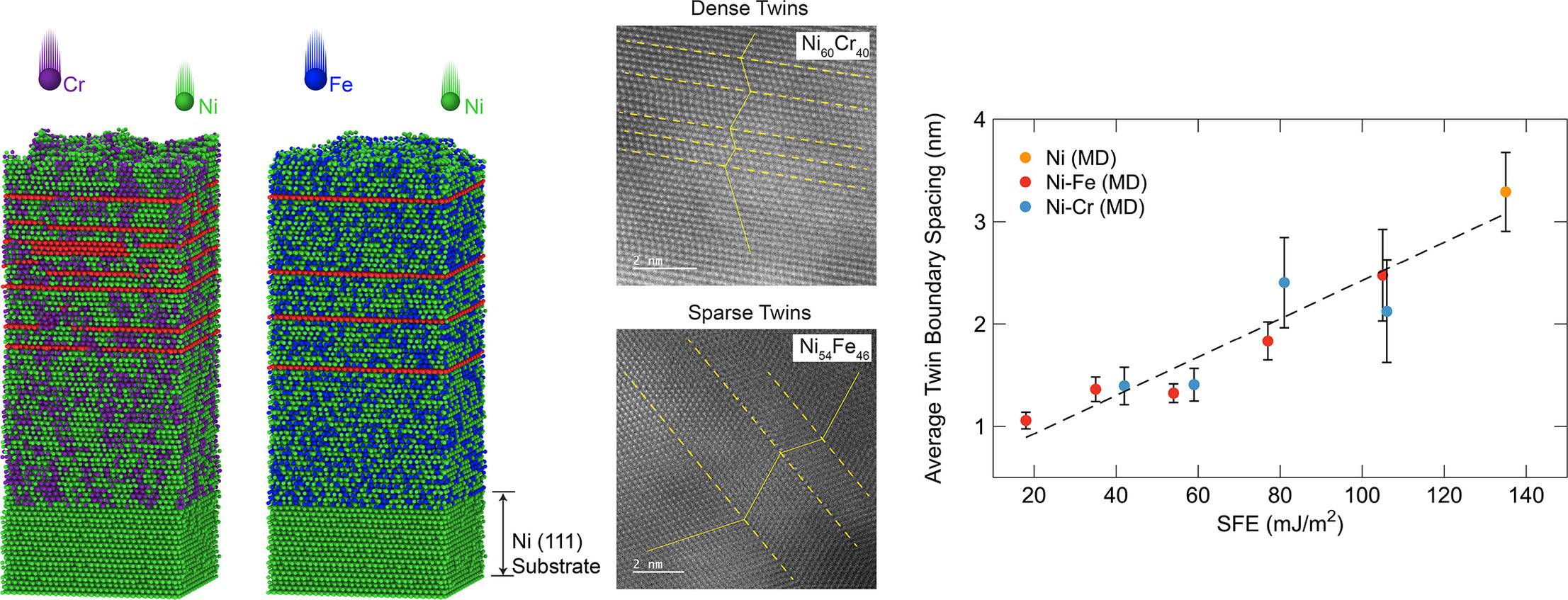
Abstract: In this study, molecular dynamics (MD) simulations are combined with magnetron co-sputtering experiments to examine how Ni-Fe and Ni-Cr compositions affect defect energetics and twin microstructure in thin films. These simulations represent the first direct modeling of nanotwin formation during atomistic thin film deposition. Ensemble MD simulations reveal substantial stochastic variability in grain structure and twin development across deposition runs, yet clear compositional trends emerge. Cr-rich Ni-Cr alloys form dense twin networks with narrow spacing, while Fe-rich Ni-Fe alloys exhibit fewer twins with significantly larger spacing. Scanning transmission electron microscopy (STEM) of Ni-Cr films confirms the predicted high twin density and reduced spacing, validating the link between alloy composition and growth twin formation. Notably, both simulations and experiments reveal that the distribution of twin boundary spacings is log-normal, reflecting the stochastic nature of twin nucleation during deposition. Composition-dependent maps from MD simulations further demonstrate that small variations in Ni-Cr and Ni-Fe chemistry can systematically tune twin boundary formation and enable the design of nanoscale twin architectures. This integrated computational-experimental study establishes a clear inverse relationship between stacking fault energy and average twin spacing, offering a pathway for engineering nanostructured coatings with tailored twin networks and enhanced properties.
Recommended citation: Yazdani, M. H., Liang, A., Otero, A. J. M., Liu, Y., Farkas, D., Hodge, A. M., Rupert, T. J., Beyerlein, I. J., & Branicio, P. S. (2026) "Composition-driven nanotwin engineering in sputtered Ni-Fe and Ni-Cr films: linking fault energetics to twin thickness." Acta Materialia, 306, 121890. https://doi.org/10.1016/j.actamat.2025.121890